Professor Barbara Williams of Missouri State University-West Plains has been studying and documenting examples of Ozark native stone masonry for the past 20 years.
Professor Barbara Williams of Missouri State University-West Plains has been studying and documenting examples of Ozark native stone masonry for the past 20 years.
Ozark native stone masonry is an architectural style of the early 20th century in Missouri, Arkansas and Oklahoma.
Artists, writers and masons from across Missouri gathered in West Plains on May 14 to celebrate and brainstorm ways to preserve the Ozarks’ giraffe rock architecture. The colorfully built structures date to the early to mid-20th century and are defined by use of native rocks like chert, limestone, and sandstone. Although giraffe rock technically refers to only one specific form of this masonry, the term in the 21st century has been applied to all of the surviving styles from that era.
“I see these rock buildings as a metaphor of hard-working people of the Ozarks and how they picked up all these rocks from their property and made something beautiful out of them,” said Professor Barbara Williams of Missouri State University-West Plains, who led the May 14 discussion. Her presentation was held at the Garnett Library as a monthly program of its Ozarks Heritage Research Center.
William teaches art at West Plains and has devoted the past 20 years of her life to documenting and studying the Ozarks’ giraffe rock architecture. She said some examples of its construction can be found from the early 1900s, but the craft saw its golden era from the 1920s to the 1950s. Among its uses were for homes, schools, barns, and even service stations. Their range stretches from southern Missouri to northern Arkansas and into northeast Oklahoma.
“A good reason why they were so prolific was that there were so many rocks,” Williams said. “People say that it practically rains rocks here. Rocks are a cash crop, and that's true.”
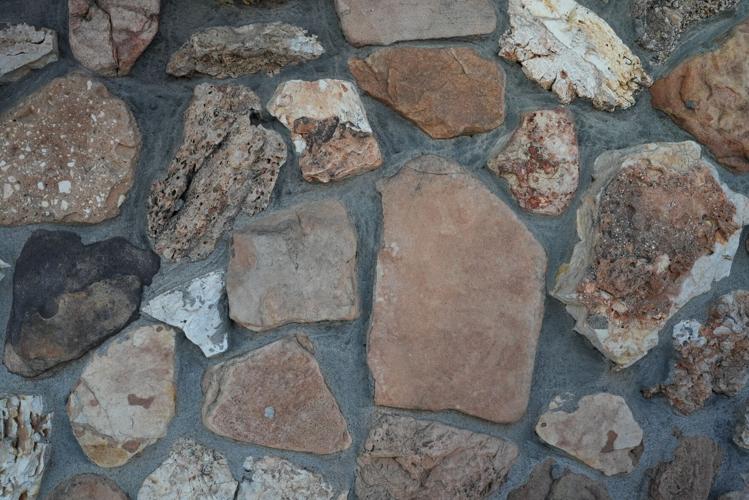
Williams said two primary styles emerged in the construction of the Ozarks native rock buildings. There is the field stone style which used rocks of all shapes and textures as building blocks. The slab rock style was more selective in the rocks used, with large flat slabs of quarried sandstone being particularly cherished.
Giraffe Rock is one of the more creative forms of slab rock style. It weaves together flat earthtone rocks, raised mortar and sometimes white paint. The overall look it creates is likened to appearing as if it were a giraffe’s spots.
“Giraffe rock is the Ozarks contribution to architecture, and it’s something to be proud of,” Williams said.
During her presentation, Williams shared photos and original paintings of the more curious examples of Ozarks native rock buildings that she’s documented. She said they inform a book on the subject she is planning to publish. Among the examples she spotlighted are the Harlin Museum in West Plains as well as the Couch School and the WPA-built Wilderness School of Oregon County. She added fans wanting to see many examples should visit Thayer as the town is an epicenter of the artform.
Unfortunately, a growing reality Williams cited is many giraffe rock buildings and other native rock structures are being lost to development or deterioration. She said even in the span of the 20 years she’s been documenting examples some have fallen into neglect.
“Too many of these buildings have not been appreciated,” Williams said.
Among those in attendance on May 14 were new and longtime owners of Ozark native rock buildings. They shared their knowledge on maintenance and best practices for preservation. No nonprofit yet exists solely dedicated to preserving Ozark giraffe rock buildings. Whether one can or should be created was among the topics of post-presentation discussion.