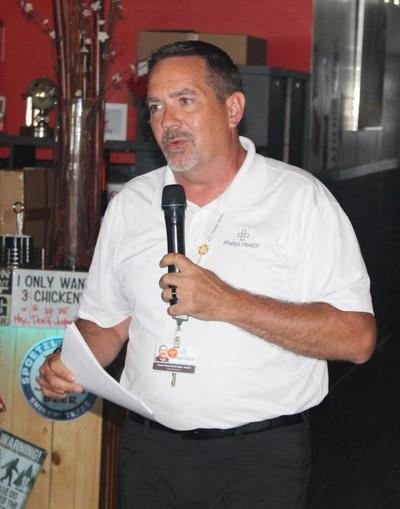
Jason Shenefield, president and CEO of Phelps Health, gave updates on the hospital during the Waynesville-St. Robert Chamber of Commerce luncheon meeting held Wednesday in St. Robert.
Jason Shenefield, president and CEO of Phelps Health, gave updates on the hospital during the Waynesville-St. Robert Chamber of Commerce luncheon meeting held Wednesday in St. Robert.
Phelps Health president and CEO Jason Shenefield emphasized the importance of addressing social determinants of health, such as food insecurities and lack of transportation, in his presentation as guest speaker of the Waynesville-St. Robert Chamber of Commerce during its regular luncheon meeting held Wednesday, June 12, at the Juicy Crab Shack in St. Robert.
Shenefield highlighted innovations in healthcare technology and services with a focus on improving patient experience, communication and personalized care, including a virtual visit platform and 24/7 cardiac catheterization lab. And, he said there is a need to “deepen the bench” in the organization’s specialty areas so when the hospital hires a specialist to provide a new service not previously provided, patients can count on continuation of the service long term.
In the Waynesville clinic, Shenefield said, there’s been a high demand in outpatient therapy, so a renovation and expansion are planned. Also, the MRI machine, which has been at the clinic since the facility opened nine years ago, is being replaced.
Phelps Health one of six in state chosen for pilot project
Shenefield told the group Phelps Health was one of six rural hospitals in the state to be selected for the Transformation of Rural Community Health (ToRCH) pilot project.
“This is something I’m really excited about that Missouri is kind of a pioneer in this respect,” he said. “They're helping provide some funding up front to find ways of how to meet our most vulnerable population, those on Medicaid, how do we help decrease unnecessary ER utilization? And then also, how do we keep them from avoidable inpatient admissions or readmission? So anytime they end up in the hospital, there's a lot of things that we can do to get to those people out in the community before their point of crisis, and how to identify, what are the things that they may need?”
Shenefield said through the project, Phelps Health staff will work to identify the social determinants in the communities they serve.
“And so, that can be food insecurities, it can be lack of adequate housing, inability to get transportation to get to a doctor's appointment, or to commute to the pharmacy to pick up a prescription,” Shenefield said. “And so how do we meet some of those needs, meet those people where they're at, to help them connect the dots so that they're not having poor health outcomes because of a simple thing?”
He said the goal from the state standpoint, and what the state is challenging the hospitals in the ToRCH program, is to see a 10% reduction of Medicaid spending from ER and inpatient admissions and readmissions.
“We’re working with them to see how we can reduce that utilization there to provide other types of services to better meet their needs to keep them out of the hospital,” he said. “That's an exciting program that we're part of, and really diving into this year.”
Virtual visits now available around-the-clock
Shenefield gave a brief update on a partnership the hospital now has with a company that only partners with health systems and uses the same medical record program to offer virtual visits to patients around the clock.
“And the reason why that's important is, if you use our virtual visits or your virtual providers, your medical record of your visit and whatever you were prescribed or whatever you're seen for, carries over into your medical record and helps out so if you need to follow up with your primary care provider or a specialist, they can see what that refeeding care provider did for you and then continue that continuity of care,” he said.
Patients are looking for around-the-clock care and ease of use, he said, and through the program, will stay connected to Phelps Health as a provider.
“If you're on vacation, and you have a minor illness that you know doesn't require an ER visit, something maybe you go to your primary care provider, but you just want to get seen right away. You can do that,” he said.
New 24/7 cardiac catheterization lab now available
Shenefield gave an update about a new lab and taking the hospital’s cardiac care to the next level, joking, “so, the good news is, you don’t have to schedule your heart attack.”
The service began at the end of February, he said. Prior to that date, care could be provided at the hospital for someone having a heart attack between the hours of 8 a.m-5 p.m., but would have to be taken elsewhere outside of those hours.
“We can take care of you,” he said. “The team of interventional cardiologists that we have, they've been amazing. They're looking using their skill sets and seeing what other types of treatments and procedures they can do.”
The cost of doing business
“We’ve been working a lot in the past year on what's called a direct to employer health plan,” Shenefield said. “This is really where we're looking at how do we help employers save on their overall health insurance and how do we help employees save on what it costs them to receive health care. One of the things that I hear, I'm always transparent about when I'm out in the community, is I always hear you know, we're really expensive. There's a whole other 30-minute presentation we could do on why and how we got there. But the point is, we're doing this as a strategy to try to make receiving care at Phelps Health more affordable, while saving both employees and employers money, dollars that they’re spending on health insurance.”
At this early stage, he said, they’re starting to talk with employers, and due to federal laws, it must be those with 51 or more employees.
“We’re trying to identify who those employers are who have 51 employees or more and have conversations on, could we be a direct provider for their health insurance benefits for their employees with the goal of saving them money and also saving their employees money.”
Setting sights on improving experience
Shenefield said patient experience is a priority in both the clinics and the hospital.
“My goal is that when anyone uses our health system, you get a consistent experience to high quality experience, and that you feel that we're there to listen to you and understand your needs and really personalize care for what you need. You know, we haven't perfected it. We still have a way to go.”
He said as part of his job, he reads letters from patients with positive and negative experiences, and communication is part of improving services.