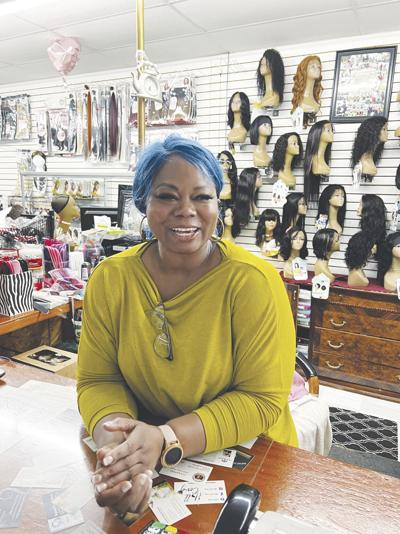
Whether it be the Powerball or a gift-card drawing at a local shop, everyone has won the lottery. While some prizes are a bit better than others, lotteries always offer the same thing: an opportunity. When Rugie Momoh won the Visa lottery, she was given an opportunity for a new life.
“I was born and raised in West Africa, Sierra Leone,” said Momoh, owner of JP’s Hair Supply. “I spent most of my time there. I came to the United States when I was 18 and I won the Visa lottery. And that's how I got a chance to come to the U.S. and the journey has been great.”
For some, participating in a lottery- whether buying scratch-offs, choosing omniscient numbers, or checking the draw- can take a ceremonial, anxiety-ridden edge. However, for Momoh, when she entered the Visa lottery through the Diversity Visa Program, the only fear that fueled her actions was the fear of missing out on a hangout.
“The lottery was just like going to the store and getting a scratch-off but this one involved paperwork,” said Momoh. “You had to meet certain requirements. They take your picture, you fill out the necessary materials. Then they send it off here, to America, and if you win then they reach out to you to let you know. For me, [winning] just happened. There was a group of girls and one gentleman [going to enter the lottery], and then my neighbor said, ‘Hey, Rugie, you want to come?’And then it just happened. I didn’t push but it happened.”
While Momoh entered the lottery with friends, she won alone.
“What I miss most about my home is family,” said Momoh. “The love and family time. I miss that a lot. Thank God for the internet now and of course, social media. So it's a lot easier now than then. Back then we had to buy a calling card. I spent about $10 on a calling card and it might give me 20-30 minutes. But now we can talk freely and on Facetime so it's getting better. My family is everything. I grew up with my mom, my dad, my uncle, cousins and nephew. You name it. I miss my family the most and then the culture is just really, really different here.”
In Momoh’s homeland, native animals that we often see in zoos roam freely- unencumbered by leashes, and cages. And West Africa is not just the land of free animals.
“The animals over there are free,” said Momoh. “They're not in the zoo...like in America. I don't like to go to the zoo. I went there one time and I will never go again. They need to be free. They are not as bad as people think they are. But I really miss home because everybody's free. And we all should be free. That's how life should be.”
In America, many find the holiday season daunting. Often times, we offer fake smiles and leave gatherings to return to separate lives. In West Africa, the people don’t celebrate Thanksgiving, but they also don’t share a culture of loneliness.
“I guess here we're a lot more spaced out,” said Momoh. “There's not as much as a community and that's what I miss the most at home. Community is all-day-every-day and not just on Thanksgiving or Christmas. Nobody's lonely over there. Nobody lives alone. Like over here when someone is old, their families put them in nursing homes. We don't have that over there. You take care of your parents or your parents take care of you. Whether they have to or not. We're always together. It's really that unity that I miss.”
In turn, Momoh has strived to create community wherever she is. JPs Hair Supply is a comfortable shop that features couches to relax in, bright colors, and “You’re All I Need to Get By” playing softly in the background. However, JPs Hair Supply is a community because of Momoh’s work ethic and mindset - not just because of Marvin Gaye’s sweet melodies.
“Coming to America is everyone's dream but it's not really what I expected. I didn't know when I came I would have to work so hard and push myself to achieve what I wanted,” said Momoh. “But I don't regret it. I don't regret it at all. Here they don't have the community that we have back at home. So I'm like, ‘Okay, if there's none, then I'm trying to create one.’ That's what I'm trying to do here. I have the sitting area and everyone is welcome to that. You come with a friend or just if it's hot outside. I have a bench outside. A couch inside. Come and feel comfortable.”
However, creating community, working hard, and taking care of others was Momoh’s dream far before the ‘American dream’ clutched her heartstrings.
“It has been a dream- a dream I have had since I was eight years old,” said Momoh. “ I always wanted to own my own business. I grew up in a family where my mother was an entrepreneur; everybody works a job. But I always had this big dream that one day I was going to be somewhere- I just didn't know where. I would tell my mom that ‘one day, I'm going to take care of you.’ I wanted to open up a store. I wanted to have a bunch of people working for me. I didn't know where it was coming from. But it has happened.”
Momoh took the opportunities she won from the Diversity Visa Program and used them to create an extraordinary life in America. However, whether she is ‘winning’ or ‘losing,’ she always makes the most of her situation.
“That dream didn't go away,” said Momoh. “When [my husband and I] ended up here from Germany there was nothing much going on. My boys were still a little bit younger so I worked for the post a little bit with the childcare center. And I didn't like that very much because I'm like, ‘I am supposed to be telling these people what to do, not them telling me what to do.’ I just had that mindset. They were great people though. Then my son got sick- he was diagnosed with cancer. Going through that treatment in St. Louis I learned a lot. He started losing his hair. After he lost all his hair they took us to this wig room to see. I'm like ‘he's a boy. He can't wear a wig.’ But immediately my dream came back to life. I was like, ‘this is it.’ My husband and I took turns coming home. One day I saw an empty building over there by Papa John's. I went to look through the window and the landlord was there. And I said ‘I want this building.’ I didn't have money. But I had this experience. I had this God-given talent. I was going to make it. Today, my son is doing good. He's in remission. He's a junior at Waynesville High School. But I wanted to give back to the community. And that's what I've been doing. Today is my 15-year anniversary in business. It has been a journey. There have been of course ups and downs, but I am focusing on the positive ones. I'm not going to dwell on the negative. At the end of the day, what I have achieved in life is more than the negative.”
While Momoh strives to create community wherever she is, she has not been able to return to her original family- yet.
“I have not gone back home,” said Momoh. “I miss them so much. But I have done great things that even if I don't go back they are okay. I have made a provision for them. They have a roof over their head. Everybody's established. They're able to make money to survive. My mother comes and visits. I am planning to go this year by the grace of God for the first time. I'm going to surprise them. But I don't regret anything at all. Everybody's like a family to me now. I try to make a family because there are a lot of lonely people around,
While not much in Momoh’s life has been easy, her love- for others, her community, and learning- has been.
“It has been a journey, but it's all good,” said Momoh. “I'm very grateful. In the beginning, it was a little bit difficult, cultural reasons and distance away from my family, but it has been great. I have met great people along the way. I have learned a lot and I'm still learning but I'm grateful. The biggest lesson is not to take anything too seriously. I'm just taking it as it is. I'm not putting pressure on anything. We put so much pressure on life, but just take it day by day. That's what I'm doing. I'm enjoying the moment. Don't hold on to anything too long. Let it go. If someone hurts you, talk about it. It's easier to love that way. Everything is a learning process. We may not finish everything today, but we will save it for some other time.”