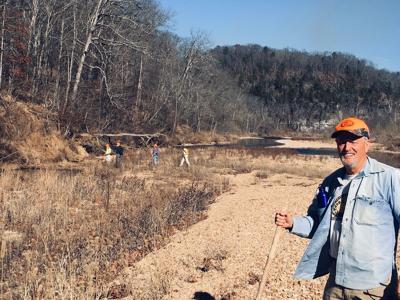
Oral historian and author Alex Primm hiking along the Jacks Fork riverway in Shannon County. Primm’s "Ozark Voices: Oral Histories from the Heartland" was published this year by McFarland & Company, Inc., Publishers.
Oral historian and author Alex Primm hiking along the Jacks Fork riverway in Shannon County. Primm’s "Ozark Voices: Oral Histories from the Heartland" was published this year by McFarland & Company, Inc., Publishers.
Alex Primm heard hundreds of stories during his writing career in the Ozarks while getting to know some of the region's most captivating people. Whether as a newspaper reporter or professional oral historian, Primm’s adventures took him from interviewing conservative back-to-landers deep in the woods, to spending a day with the Rainbow Family and also listening to some of the everyday people who’ve keep society functioning.
Primm’s "Ozark Voices: Oral Histories from the Heartland" includes scores of such tales collected from 40 years of professional documenting. There are also more than a few contemporary insights. The book was put into print this year by McFarland & Company, Inc., Publishers. It is now for sale online and at select booksellers.
“The longer a person lives in this region the more you realize it's very complex,” Primm said of the Ozarks. “It's not just hillbillies and Scotch-Irish people. There is a lot of diversity. It is slowly changing, almost imperceptibly, but it is changing. The longer a person is here though, the more I think one grows to appreciate those values that don't change. It takes a while to realize what’s special here, but when you do, the Ozarks really grows on people.”
Primm originally grew up in St. Louis and first came to know the Ozarks through youthful float trips on the Meramec River. After military service overseas in Vietnam, and graduating from St. Louis University, Primm decided in 1972 to accept a reporter job at the Rolla Daily News. From there, Primm made the Ozarks his home while also working for the U.S. Forest Service, U.S. Geological Survey and James Foundation. Along the way he also became a trained oral historian.
“The main thing oral historians want to do is establish rapport in a comfortable environment so the person being interviewed is comfortable and shares more. We want them go back into their memories and dig up things they haven't thought of in years,” Primm said. “The field has adopted very sophisticated methodology using almost entirely digital recording methods. There are people who come to it from a journalistic background. Others are more interested in folklore. Some are people who are interested in family history or are activists who want to document their community.”
Primm has recorded countless local stories over the years. One of his favorites from Phelps County came by way of his newspaper days.
“Earl Adams and his wife had dozens of foster children and lived in St. James. It was one of the first stories I wrote when I was working for the Rolla Daily News,” Primm said. “They were such an inspiration. They had several children of their own and they had all these foster kids, most of them who had special needs of one kind or another. They just impressed me so much, partly because of that, my wife and I became foster parents.”
Some of Primm’s best work also comes from next-door Pulaski County. Among his notable interviews is former County Clerk George Lane sharing the tale of being deputized to raid an illegal still as a young man.
“I had always thought Pulaski County would all be dominated by Fort Leonard Wood, as one would expect, but I did oral history along the Big Piney River between the fort and the Gasconade River and interviewed several people,” Primm said. “There are quite a few families in Pulaski County who have been there for four or five generations. There is an old Pulaski County that has a lot of respect for their heritage and there's people who are doing great things to protect the quality of life and the history of Pulaski County. It's just not a big military base with a lot of bars.”
A common thread of Primm’s work is the uniqueness of Ozark people and their surrounding environment.
“In other parts of the country they don't have the extremes that we do with drought and high temperature, rain and floods, soil that is not always desirable and needs to be mended,” Primm said. “There was a folklorist named Vance Randolph who worked from the 1920s into the 1950s. He wrote a number of books about the Ozarks and regretted that the old timers, he called them the ‘hill crofters’ were dying out. The people who were basically subsistence farmers and met some of the ideals of a real hillbilly. He said those people are dying out and that the Ozarks are changing rapidly. But, he said in an interview just before he died that actually the Ozarks, as a region, still attracts unique people. We don't have the subsistence farmers so much anymore, but there are people who come here for a variety of different reasons who want a lifestyle that's not so possible elsewhere.”
Primm reports he’s already working on another similarly themed book while continuing his residence in Springfield.
“This took me 10 years to put together, but I learned a lot,” Primm said. “I didn't want just a collection of essays. I wanted to create a sense of how I got to learn about the Ozarks as you read through the book. There's like 60 different short pieces, and anyone can read them in any order, but I tried to have somewhat of a dramatic arc to the collection.”
Primm closed his own interview by recommending the younger generations give oral history a try.
“These days everyone has a cell phone and loves to take pictures. I would encourage them to add to those pictures by getting a few stories down on a digital recording,” Primm said. “It’s not that hard to do. I think people in the future will be glad to have those stories and history to go along with those photographs.”