Have you noticed the names of school districts in Missouri and that odd letter “R” at the end? You see it with Waynesville R-VI, Plato R-V, Camdenton R-III, Lebanon R-III, Iberia R-V, Springfield R-XII, or Laquey R-V. What gave them that unique suffix? I have military friends who have told me they thought it stood for “rural.” No, not the correct answer.
Beginning in the 1950s there was a move to consolidate the smaller schools in a county in order to offer better educational opportunities that might not be found in a smaller school setting. According to the Missouri Department of Elementary and Secondary Education, the “R” in some district names represents that reorganization of those districts and the order of the local mergers. Schools can also vote to remove the “R” designation, as in the case of Newton County R-V, which became the Neosho School District.
By state law, schools are allowed to voluntarily consolidate or merge with other schools and create new, larger districts. They have a “C” in their names denoting that consolidation, such as Braymer C-IV, Gasconade C-IV, and Clarksburg C-II. Today, there are 567 districts in Missouri, without consolidation and reorganization there would be thousands.
By 1860, Waynesville School had become the largest school in the county. In fact, a Union soldier remarked in 1862, "Our march on the 18th, brought us to Waynesville, a small village of fourteen homes. This town was remarkable for having in it a schoolhouse, the only institution of this kind that we had yet to meet within the state."
The teacher's salary per month in Waynesville was $25 in 1860. In 1878, the salaries for male teachers were $29 and female teachers, $19.
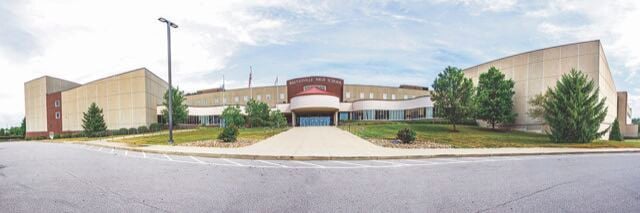
Our school district became the Waynesville School District in 1886. Later Waynesville R-VI School District was created on August 4, 1949, when they took in six smaller area schools in Pulaski County. The schools that were reorganized were Anderson, Hooker, Maze, Mount Gibson, Shady Grove and Shockley. Here are a few tidbits of information about them.
Hooker School was designated "Missouri's Smallest High School" in 1929.
Maze School was located southeast of Devil's Elbow and the Big Piney River.
Mt. Gibson School was located five miles south of Waynesville. It was approved by the state in 1915. An early teacher was Nan Pippin, of the Dru Pippin family.
Shady Grove School was located on T Highway. There was some interest in saving the building, but nothing came of it. The Waynesville School District took sealed bids in 2011 in order to sell the property. The building has been torn down, taking with it many years of history.
Anderson School got its water from Bushwhacker Cave Spring and was organized in 1906, near the junction of Highway 28 and old Highway 66. Many of Pulaski County's founding families' names are seen in its history: Helms, Sandifer, Anderson, Rigsby, Long and Bates.
Shockley School was located four miles north of Waynesville. Other founding families' names can be found there: Zeigenbein, Shockley, Burgess, Booker, Skinner, Fuller, Turner and Robinson.
I am proud to be a lifelong educator and 15 years of my career were at Wood Junior High at Fort Leonard Wood. It was of course named for General Leonard Wood, a medical doctor, an engineer, a Medal of Honor winner, and a politician. I am also a history teacher and have always been interested in honoring our local history and reminding people of our heritage. Since I taught at Fort Leonard Wood the schools and locations there have always fascinated me.
Our school names have interesting origins. East Elementary bears that name because at the time it was built it was located in EAST Waynesville. The current Administration building was known as West School and was an early elementary building.
The schools on the installation are managed by the Waynesville School District and many of the public schools at Fort Leonard Wood (FLW) were named for superintendents of West Point. There have been 61 superintendents since 1801. Some the FLW schools have become inactive over the years, but at one time they were busy places.
The Spanish American War period is represented by Leonard Wood himself and a street is named for General George Washington Goethals, honoring the man who helped to build the Panama Canal. Delafield Street honors General Richard Delafield, an Engineer and West Point superintendent. General Joseph G. Swift, the first graduate of West Point and later a superintendent, is also honored with a street.
Pershing Elementary honors a Missouri General and commander of the AEF of World War I. General Garrison Davidson was a superintendent of West Point and also served as a football coach for the Black Knights. He is honored with the Davidson Fitness Center.
The first superintendent of West Point was General Jonathan Williams, 1801-1812, a nephew of Ben Franklin and chief of the Engineers. In fact, he seemed to be in constant arguments over the building of West Point and it put him on the wrong side politically. But the actual building and fortification of the Point is attributed to General Williams.
In 1814, Alden Partridge became the leader of West Point. His term was not known for being exemplary. In fact, at one point he was court-martialed.
In 1817, Sylvanus Thayer was appointed superintendent by President James Monroe and served until 1833. He is known as “the Father of West Point” because of his focus on engineer education. Another FLW school was named for General Arthur Pence, who was the Engineer commander here at Fort Leonard Wood.
It is important to remember and honor our past. I wish you all the best school year ever and now you know a little history behind the school district you are attending.
Credit to the Waynesville R-VI School District and the Old Settlers Gazette