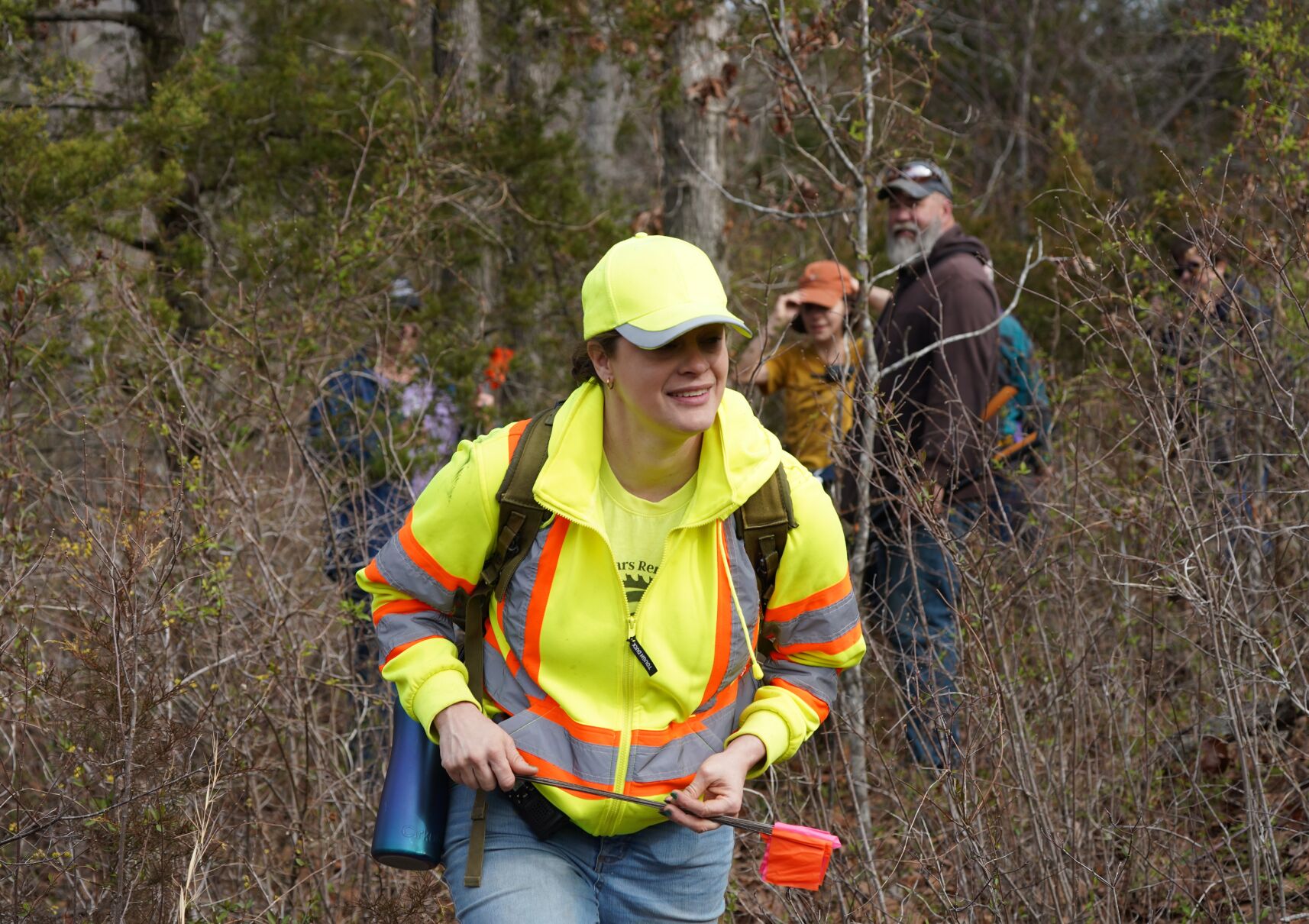
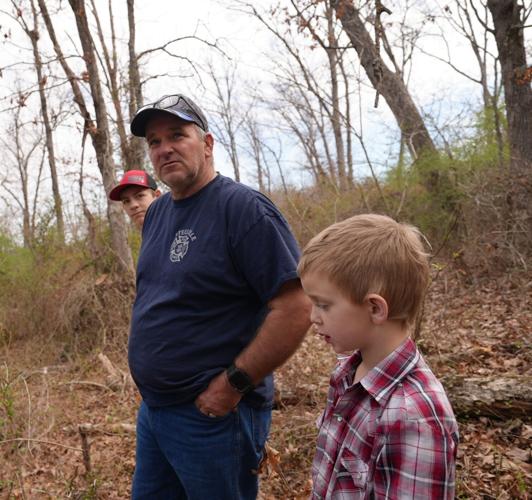
Archeologist Erin Whitson led the pedestrian survey outside Steelville on Saturday to find a lost cemetery believed to hold the graves of Cherokees who died on the Trail of Tears.
Archeologist Erin Whitson led the pedestrian survey outside Steelville on Saturday to find a lost cemetery believed to hold the graves of Cherokees who died on the Trail of Tears.
Photo by Andrew Sheeley
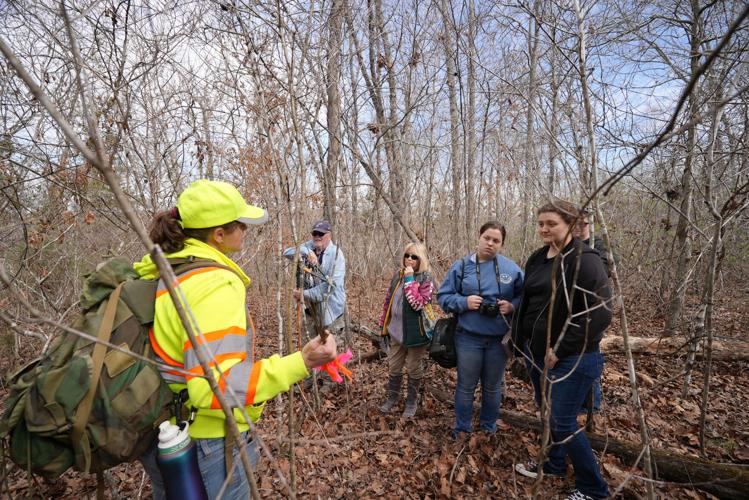
Volunteers on Saturday completed a pedestrian survey by marking places where the lost Davis family cemetery may be located.
Photo by Andrew Sheeley
Mike Davis was among the Davis family descendants who took part in searching for the family’s lost pioneer plots, along with his sons and sister.
Aridge overlooking Steelville saw volunteers gather Saturday in hopes of solvingahistoricalmystery.Lost to the modern world is thelocation of theoldDavis familycemetery.The site isknown toat leasthold the graves of the pioneering Ozark family. It’s alsobelievedCherokees who died on the Trail of Tearsrest there.Thevolunteers over many hours fanned out through theforest andthickets markingthe bestspots ofpotential discoveryduring a pedestrian survey.
“We are trying to find witness sites from the Trail of Tears, places that would have existed at the time the Cherokee, and people on their way west with the Cherokee, would have seen and maybe spent a moment of their lives,” said archeologist Erin Whitson,who led the Saturday projectand is working with the Steelville Trail of Tears Remembrance Committee. “I think this is important not just because it tells Steelville’s story,but because it tells a story of national significance. This happened over 150 years ago, but the legacies of these things still haunt us today.”
Allen Davis, his wife and daughter are known to be buried in the lost cemetery. Theywereamong the first settlers of Crawford Countyand lived on a homestead near Hoppe Springwhere Steelville later developed. When the Cherokee were forced west to Oklahoma in the late 1830s,the Davis family found themselves living along what would become known as the Trail of Tears. Within the span of months thousands ofCherokees passed byinseveraldetachments.Sickness, exhaustion and exposure were prevalent.Many died during the journey and were buriedaway from home.
“Steelville was only two years old when the Cannon Detachment visited and then three years old when the main groups came through. That first party had 365 people in it. The following year more than 10,000 came through in just a few months,” Whitson said. “We know the CanonDetachment came through in 1837, a year before the forced removalarrived. They were leading the way through for everyone else, and the forced removal groups generally stopped where the Canon Detachment stopped. By the time Canon reached far eastern Crawford County the majority of his party was so sick he had to stop. They stayed three or four days at one site, then moved up to another that we know had shelter in the form of a schoolhouse. They stayed there for a week or so, and then they started towards Steelvillewhere our best is they stayedwhere the community park is today.”
Among the volunteers Saturday were descendants of the Davis family. They said its long been family lore that Cherokees were buried in the old family plot. Ownership of the landin which they restedwas located switched hands over the years. What traces of the graves endured wereunfortunately erased when the ridge was loggeddecades ago. Thesite isidentified in KennyFiebelman’s Ozark Heritage genealogical book seriesas the“Davis-Wittenberg Cemetery.”
“This is something that should be preserved,” said Mike Davis. “Allen Davishungthe door for the first business in Steelville.”
Mike’s sister,Erin Harmon,agreed.
“For us this is very personal,” she said. “Family is very important to us, and we want to keep connected to one another.”
In addition to Cherokee gravesthe old Davis cemetery may also hold the graves of slaves who were forced west with the Cherokee.
“There were some enslaved Africans with the removal group who were very sick, andone account says a couplewere left with the Davis family to be cared for,and if they didn't survive, they were supposed to bury them,” Whitsonsaid. “We don't know what happened to them. We have no records after the point of Cannon Detachment being there and leaving those two people. We don't know for sure the CanonDetachment had anyone buried in there, but the fact that we have oral histories makes me thinkit’sreasonable to suspect there may be Cherokees or the enslaved people of the Cherokee there.”
The Saturday project is part ofseveral efforts of the Steelville Trail of Tears Remembrance Committee.Another projectseeks to have amonument memorializingthe Tear of Tears erected in Steelville Community Park.
“We can't ever fixwhat happened. We can't ever go back and make that better, but at least acknowledging that it happened I think is a start to trying to reconcile with this history.” Whitson said. “If we find the cemetery, I think it’s our best bet for doing something preservation wise. It would be something that might qualify for National Register qualifications, at least for the potential to learn things under Criterion D. We could learn a lot about Steelville and the Trail of Tears.”