Pulaski County and Waynesville sit in south central Missouri in the middle of America. We sit on Historic Route 66 and Interstate 44. Waynesville sits high atop the Ozark Mountain Ridge and our neighboring towns sit deep in its valleys. The ridge controls our weather patterns and helps make the decision of whether a storm reaches our area or stays to the north or the south. There are five chartered cities in the county: Crocker, Dixon, Richland, St. Robert and the county seat, Waynesville.
The Roubidoux Creek is one of the jewels of Pulaski County and even though it can “roar” occasionally, we love its natural beauty and the opportunities it affords us. Waynesville is truly a town with “a river running through it.” Local folklore claims “Dip your toe in the Roubidoux, and you will always come home!”
For inquiring minds, Joseph Roubidoux was a French explorer, known for settling and designing St. Joseph, Missouri, which he named for himself. Even though a legend tells of him camping along the Roubidoux, it is believed he never set foot in Pulaski County, but we are all familiar with his name around here. With the Roubidoux, we boast the only urban Blue Ribbon trout stream in Missouri, and the Roubidoux Spring is known nationally as one of the largest underground cave systems for cave divers. Downtown Waynesville sits atop that underground cavern.
Waynesville is full of history, and we remember the infamous Trail of Tears. We honor the Cherokee people who traveled the Trail through the early village of Waynesville with a National Park Service interpretive exhibit. The site is a stop on the National Historic Trail. The Roubidoux Spring, in present-day Laughlin Park, was the site of encampments of the Cherokee Indians as they were forced to move along the Trail of Tears in 1837 and 1839. Bands of starving Cherokee Indians made their way across southern Missouri into Indian territory, camping along “the banks of a beautiful stream named Rubedoo,” as one diarist described it.
We were also impacted by the divisive American Civil War, as Waynesville and Pulaski County became examples of “brother fighting brother” in the War Between the States. The Old Stagecoach Stop sits on the square in downtown Waynesville as a testament to that division. Commandeered by the Union Army as a hospital, the Stagecoach Stop stands as the oldest building in Pulaski County still in use.
We are proud of Route 66 running through our downtown and the 33 original miles of Route 66 in Pulaski County. We are proud of an original Route 66 bridge, built in 1923, in downtown Waynesville. It recently celebrated its 100-year anniversary. The bridge contains five 80-foot concrete-filled spandrel arches, replacing a steel suspension bridge on North Street, the original route of Route 66. The piers of the old bridge are still visible there. In 1939 the concrete bridge was widened to accommodate the building of a new Army post in our county.
In 1990, Missouri Gov. John Ashcroft signed the “Historic Route 66” designation in front of our courthouse, one of two original courthouses, along with Joplin, to sit directly on Route 66 in Missouri. In recent years Route 66 tourism has become an important part of our downtown revitalization, and we are readying for the centennial celebration of the “Mother Road” in 2026.
Of all the historical events that took place in our county, the building of Fort Leonard Wood would have to be the most significant for us. As war was reaching the U.S. in the 1940s, Missouri’s U.S. Sen. Harry Truman succeeded in bringing an Army training center to central Missouri. The new post needed a name.
The policy for naming Army posts was originally left to the local commanders. By WWI there was an informal policy adopted that included choosing a person from the locale, choosing a person who was not unpopular, and the person could not be living. The Chief of Staff then made the final decision. But in 1939 the Army adopted a formal policy which gave the authority to the Secretary of War, with approval of Congress.
At the top of that list for many years after his death in 1927 was Maj. Gen. Leonard Wood. In 1940 the Army established the Seventh Corps Area Training Center in Missouri. The suggestion was to name it after MG Leonard Wood of New Hampshire, a surgeon, a former Army Chief of Staff, a hero of the Spanish-American War, and the Governor-General of the Philippines. There had been several efforts to honor General Wood.
In 1928, his name was proposed for a post in Maryland; again local pressure caused it to be named for Gen. George Meade.
In 1930, Fort Leonard Wood was proposed in Georgia, but local pressure led to honoring Gen. Henry Benning.
In 1932, his name was proposed in New York, but later the post was named for Gen. Hugh Drum.
In 1938, Fort Leonard Wood was to be used in Chicago, but local pressure, once again, led to it being named for Gen. Phillip Sheridan.
And in 1939, as war is breaking out in Europe, plans to build a Fort Leonard Wood in southern Iowa never materialized due to the influence of Sen. Harry Truman, who had made a name for himself dealing with national defense in the Senate. That influence brought Fort Leonard Wood to southern Missouri, forever changing the face of Pulaski County.
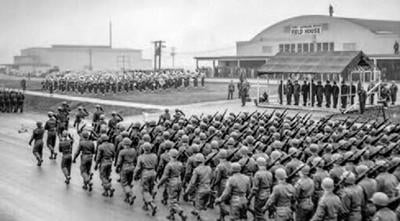
Breaking ground for the new post in December 1940, the “Pulaski County Democrat” reported that 20,000 people in one week arrived in Pulaski County. Waynesville’s population at the time was 250. The building of Fort Leonard Wood took six months and forever changed our county and our local communities. In a 1941 issue, LIFE magazine featured a story detailing the severe housing shortage the small town of Waynesville suffered. Renting chicken coops, barn stalls, beds by the hours, and garages were common occurrences, but within months training had begun at the new post.
The Army planned a 68,000-acre training center that would accommodate 32,000 enlisted men and 1,200 officers. The original construction plans cost $8,400,000 for 434 barracks, 14 post exchanges, and two theaters. Opening in December 1941, the post eventually trained over 300,000 troops during WWII.
Whole towns were displaced in Pulaski County when Fort Leonard Wood was built in 1940-41. These six towns, Wharton, Tribune, Bloodland, Cookville, Wildwood and Palace disappeared forever. Very little is left of these communities; in Bloodland, a cemetery; in Palace, a school building; and in Tribune, Forney Field and the Waynesville/St. Robert Regional Airport.
In 2017, Waynesville’s City Council voted to name the streets in the new Industrial Park after these displaced settlements. Another memorialization of these lost villages are the call letters for Forney Field Airport at FLW and the radar designation on the Weather Channel. The designation is TBN, as the original location of the airport area on post was the Tribune community.
Fort Leonard Wood was a busy place during World War II. Waynesville was the gateway to Fort Leonard Wood and housed important functions for the community, from a bus station to the USO. It also was home to several bars and tattoo parlors, which inevitably appear near military bases. Waynesville was a vibrant military stopover during the war. But in March 1946, FLW was inactivated and for a few years served as a site for cattle grazing and training for Army Reserve and National Guard troops.
Fort Leonard Wood was reactivated in August 1950 as the Korean Conflict began, and St. Robert, was chartered as a new village in October 1951. But once again, after the Korean War and the Vietnam War, downsizing affected Fort Leonard Wood, and the local area declined. Our economy was forever tied to our neighbors, and we felt the ebb and flow of its history.
In 1992 a BRAC (Base Realignment and Closure) decision gave a new mission to Fort Wood, and the Engineer School moved to FLW. With other missions of Chemical and Military Police training arriving in 1999, the future of Fort Leonard Wood seems to be secure. The post was redesignated the U.S. Army Maneuver Support Center and now serves as a training center for joint military forces and our foreign allies. There has been recent significant investment in FLW by the federal government with a $3 million grant for a new passenger terminal at the airport and the building of a new $400 million hospital.
In 2022 Pulaski County’s population was 53,941. Waynesville’s population in 2023 is estimated at 5,411 and St. Robert’s population in 2023 is estimated at 5,457. Our communities boast a low crime rate, scenic beauty and outdoor recreation opportunities, a diverse population, award-winning schools and a low cost of living. The state of Missouri has become known as a “military friendly” state. The annual impact of Fort Leonard Wood on the Missouri economy is estimated at $2 billion. It is very common to hear at military functions that retirees at Fort Leonard Wood have chosen to stay in our region in large numbers.
Our people make Pulaski County unique, as they are welcoming and open to the many thousands of visitors who come each year for our local history, our great outdoors and to visit our military neighbors at Fort Leonard Wood. We are a diverse “down-home” folk and “no nonsense” people. We have much to offer, from interesting history to a beautiful outdoor setting. Fort Leonard Wood is a large part of our community and its story. We are proud to be their neighbors and to rub elbows daily with heroes.