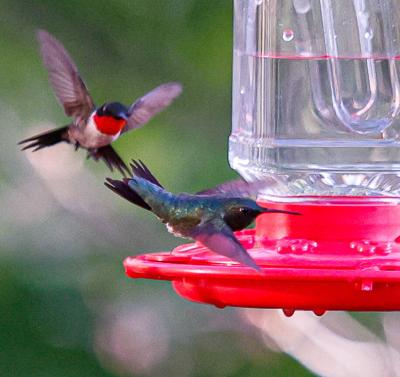
Ruby-throated hummingbirds begin arriving in early April and nesting starts in mid-May. There are many here now and their numbers will grow.
Cup-shaped nests, built on tree branches, are constructed of spider webbing, lichen, and other plant material, and lined with plant down. A hummingbird pair may occasionally raise two broods in a season. In summer, you can see broods traveling and foraging with their parents.
In August we often see a peak in numbers as northern hummers have begun to migrate through. Our Missouri hummingbirds begin migrating in mid-August; most are gone by early October.
In chilly mornings or evenings in early spring and late fall, you might occasionally see a hummingbird that appears to be sleeping, or dead. This is torpor, which could be described as a short-term hibernation, or controlled hypothermia.
Usually, warm-blooded animals, including birds, shiver to maintain their body temperature when the weather is cold. But shivering expends calories, and hummingbirds are tiny. Falling asleep for several hours, without eating, could cause a hummingbird to starve. So, to conserve energy, hummingbirds can go into torpor. Their metabolism slows.
Their body temperature can drop nearly 50 degrees lower than their usual body temperature of about 103 F, their heart rate and breathing slows, and they may appear dead. But as the air around them warms, they wake up and resume normal activities.
Most ruby-throated hummingbirds overwinter in Central America, between southern Mexico and northern Panama, with most flying (amazingly) nonstop across the Gulf of Mexico. Those that spend summers in the far northern part of the range, such as in Canada, may overwinter along the U.S. Gulf Coast, the southern tip of Florida, and portions of the southern Atlantic Coast, but they are a minority.
A hummingbird's lifespan is typically 3 to 5 years.
The ruby-throated hummingbird is a tiny bird with a long needlelike bill. It hovers and flies forward and backward with a humming sound. Males have metallic green upperparts; a red throat (gorget) that flashes ruby red in the light but otherwise may look black; underparts whitish with dull green flanks; and the tail black and deeply forked. The side of the head below the eye is black from the bill to the cheek.
Females have metallic green upperparts; whitish underparts; the sides pale buff; and the tail is tricolored: green at the base, black in the middle, with the three outer tail feathers tipped with white. Immature birds are similar to females, though young males may develop red flecks on the throat by fall.
Ruby-throated hummingbirds make a variety of “chips,” squeals, and twitters.
To fuel their high metabolisms, hummingbirds require abundant calories, which they obtain from drinking sweet nectar from flowers, using their long tongues. Hummingbird bills and tongues are adapted for reaching into the long throats of tube-shaped flowers. Some favorite Missouri wildflowers are wild columbine, trumpet creeper (trumpet flower), cardinal flower, jewelweed (touch-me-not), royal catchfly, fire pink, wild bergamot, red buckeye, and native honeysuckles. Hummingbirds are especially attracted to red or orange flowers, which is why many artificial hummingbird feeders are colored bright red.
To fuel themselves, hummingbirds consume large volumes of nectar, two or three times their body weight, each day. If humans had the same, high metabolism of hummingbirds, we would have to consume about 155,000 calories each day. This helps explain why hummingbirds are so territorial: they must protect their food resources for themselves and their families.
Many people feed hummingbirds with artificial feeders, filled with a mixture of four parts water to one part white sugar. Boiling the solution will retard fermentation and keep the mixture fresher longer, especially if you are storing part of the mixture in the refrigerator for later use. There is no need to add red coloring to the nectar. Never use honey or artificial sweeteners, and keep the feeder clean and the artificial nectar fresh.
When hummingbirds arrive in early spring , they may eat sweet sap oozing from sapsucker-drilled holes and other injured places on trees. The hummers may also eat insects attracted to the oozing sap. They soon switch to eating nectar from many different kinds of flowers as well as from artificial nectar feeders.
During nesting, hummingbirds consume many insects. Insects are a rich source of protein, required by the growing young. The young hummers are fed regurgitated food pumped into their mouths by the adult female; insects are eventually fed whole to the young. Sometimes hummingbirds steal insects from spider webs. Males defend a patch of nectar-producing flowers that will supply the needs of the pair and their young.
Although a few western hummingbirds are occasionally seen in Missouri, the ruby-throat is by far the most common in our state and throughout the entire eastern United States. Most vagrant hummingbirds from the western United States are detected in Missouri in mid- to late fall, after most ruby-throated hummingbirds have migrated south. These western species may stay into the winter, and they have been known to survive at nectar feeders heated by floodlights.
The rufous hummingbird (Selasphorus rufus) is a casual migrant most frequently observed in the western half of Missouri July through November. The male has rufous upperparts (sometimes flecked with green), a greenish head, and black tips on the tail feathers; the underparts are white with rufous sides and undertail coverts. The male's throat flashes orange-red in the light but otherwise looks black.
The female and immatures are metallic green above, with the throat spotted with brownish and orange-red flecks; the tail is rufous at the base with the outer three tail feathers tipped with white.
A few other western hummingbird species may sometimes migrate through Missouri. Anna's hummingbird (Calypte anna) is quite similar to the ruby-throat except for the male's magenta-pink (not ruby-red) face and throat. Though it mainly lives in western North America, it has been seen in Missouri.
The Mexican violetear, a tropical species that is all emerald green, with purple on the sides of the head, has been seen in Missouri at least once.
It might seem odd, but many people mistake clearwing moths for hummingbirds. These and other sphinx moths hover around flowers, drinking nectar, usually at dusk, but often in broad daylight. The hummingbird clearwing is especially hummingbird-like.